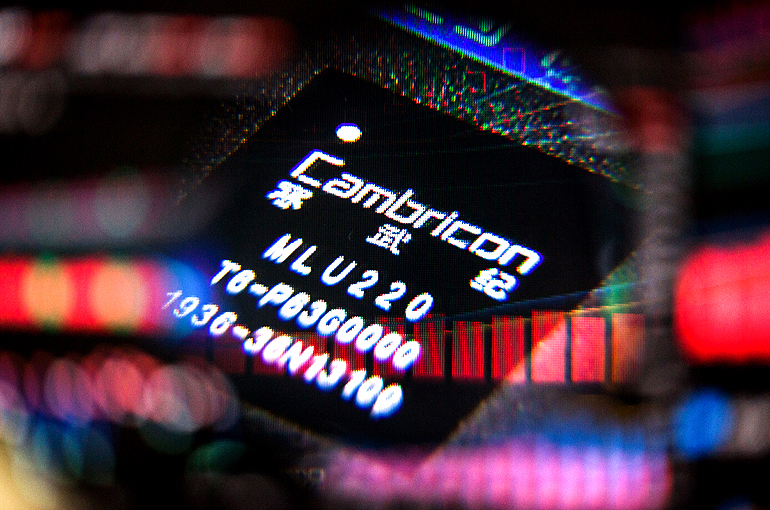
Cambricon Hits $147 Billion, Targets 500,000 AI Chips as China Races to Replace Nvidia
The Shanghai chip designer became the first Star Market stock to reach a trillion-yuan market cap, riding a domestic AI hardware push Beijing is backing with an estimated $98 billion this year.
Cambricon Technologies, the Shanghai-based AI chip designer, has become the first stock on Shanghai's tech-heavy Star Market to reach a market capitalization of 1 trillion yuan (about $147 billion) — a milestone that captures how thoroughly China's self-reliance drive has reshaped its semiconductor sector.
The company, which posted its first-ever annual profit earlier this year, aims to ship around 500,000 AI accelerators in 2026, including as many as 300,000 units of its Siyuan 590 and 690 processors. That would make Cambricon one of the largest domestic suppliers of the compute China needs to train and run frontier AI models without access to Nvidia's top-tier GPUs.
Beijing's $98 billion bet
Cambricon's ascent is inseparable from state support. Beijing's self-reliance push is drawing an estimated $98 billion in government and corporate spending across the AI chip sector this year. China has also begun publishing a list of government-approved AI hardware suppliers — Cambricon and Huawei are on it; Nvidia is not — effectively steering domestic buyers toward homegrown silicon.
The constraints
The ambitions are not without risk. Analysts point to two persistent bottlenecks: low manufacturing yields on advanced nodes at China's domestic foundries, and limited supply of high-bandwidth memory, which is dominated by Samsung, SK Hynix and Micron. Both could cap how many chips Cambricon can actually deliver against its target.
Still, the direction is unmistakable. With DeepSeek optimizing its V4 model to run on domestic accelerators and Alibaba, Baidu and Huawei all pushing their own silicon, China's AI stack is decoupling from American hardware at a pace few predicted two years ago. Cambricon's trillion-yuan valuation is the market pricing in that shift — bottlenecks and all.
Newsletter
Get Lanceum in your inbox
Weekly insights on AI and technology in Asia.