Google Begins Pretraining Gemini 4, Calling It Its 'Most Ambitious Run Yet' — With 3.5 Pro Still Missing
Google confirmed Gemini 4 has entered pretraining as a completely revamped foundation model, after the original Gemini 3.5 Pro base was reportedly scrapped and restarted — with the Frozen v2 chip program hovering in the background.
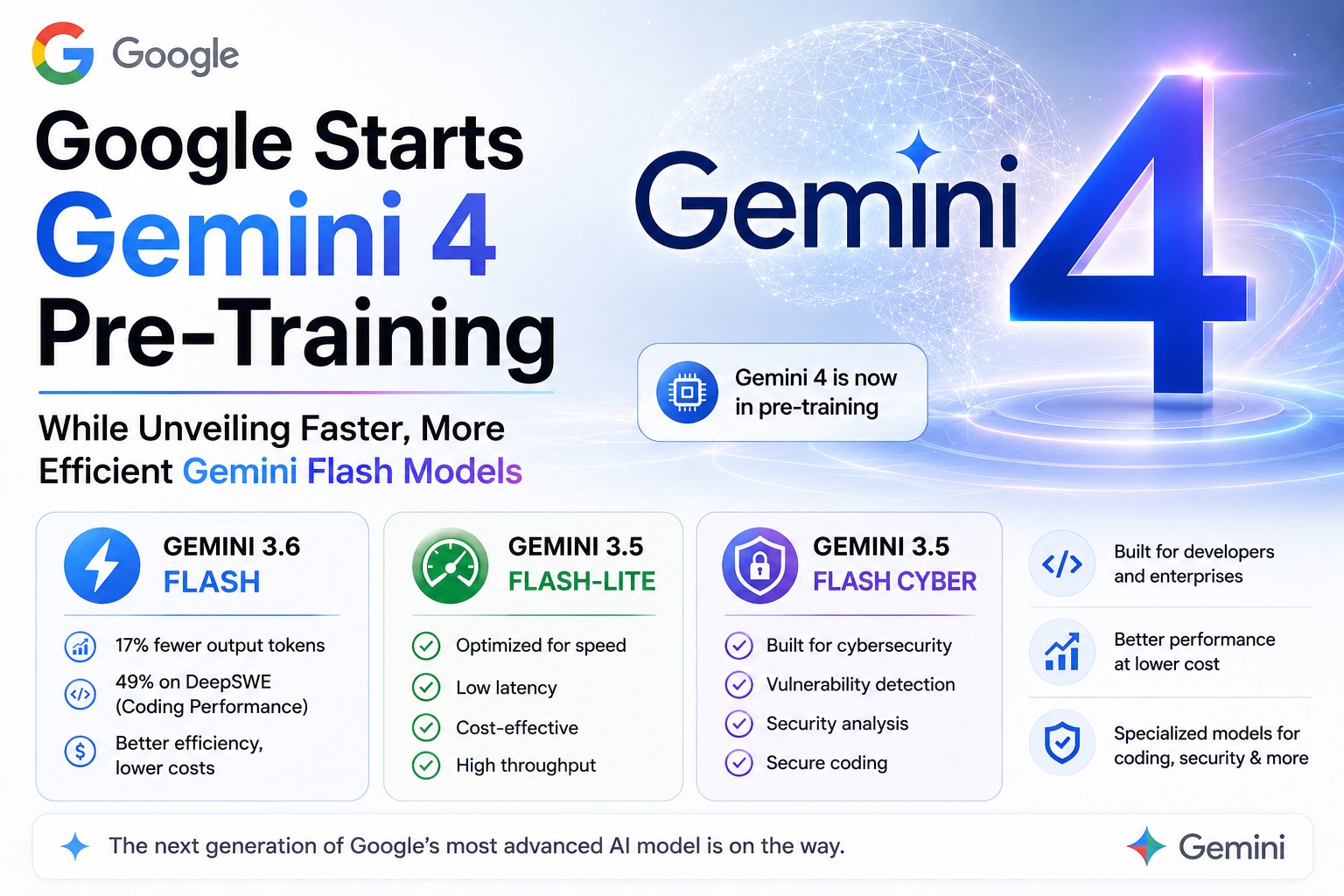
Buried in the announcement blog for Gemini 3.6 Flash was the sentence that actually matters for the next year of AI: Google has begun pretraining Gemini 4, describing it as the company's "most ambitious pretraining run yet" and a completely new foundation model rather than an evolution of the Gemini 3 line.
Reading between the lines
The confirmation doubles as an admission about Gemini 3.5 Pro, the flagship that has now missed multiple ship targets. Reporting around the announcement suggests the original 3.5 Pro base model was scrapped and its pretraining restarted after disappointing internal results — and that Google has decided to pour its frontier compute into a clean-slate Gemini 4 rather than keep polishing a troubled intermediate. The 3.6 Flash release, with its efficiency gains and price cuts, keeps the production tier competitive while the flagship bakes.
Google has published no specifications or timeline. The gap until Gemini 4 arrives will be measured in quarters — a window into which OpenAI's GPT-5.6 family, Anthropic's Claude 5 line and the Chinese open trillion-scale models are all actively shipping.
The hardware subplot
The run rests on Google's newest silicon: the training-focused TPU 8t announced at Cloud Next in April, deployed at a scale consistent with the record $44.9 billion quarterly capex Alphabet just reported. More intriguing is the reported Frozen v2 program — a chip that would etch Gemini's architecture directly into silicon for a projected six-to-tenfold efficiency gain in serving.
The two projects are coupled bets. Committing an architecture to hardware only pays if that architecture persists across model generations, which implies Gemini 4's design is being chosen partly for silicon longevity — architectural stability as a first-class training decision, alongside loss curves and benchmark targets. It is the clearest sign yet that frontier labs now co-design models and chips as a single artifact, a strategy Chinese labs adopted out of sanctions necessity and Google is adopting out of economics.
What researchers will watch
Three questions define the run. Can a clean-slate pretraining effort still produce step-change gains, or has the scaling curve genuinely flattened — as 3.5 Pro's troubles hint? Does Google fold its reasoning and agentic advances into the base model or keep them as post-training layers? And does the co-design with Frozen-class inference silicon constrain the architecture enough to matter scientifically? Google just wagered the largest compute budget in its history that the answers favor ambition.
Newsletter
Get Lanceum in your inbox
Weekly insights on AI and technology in Asia.