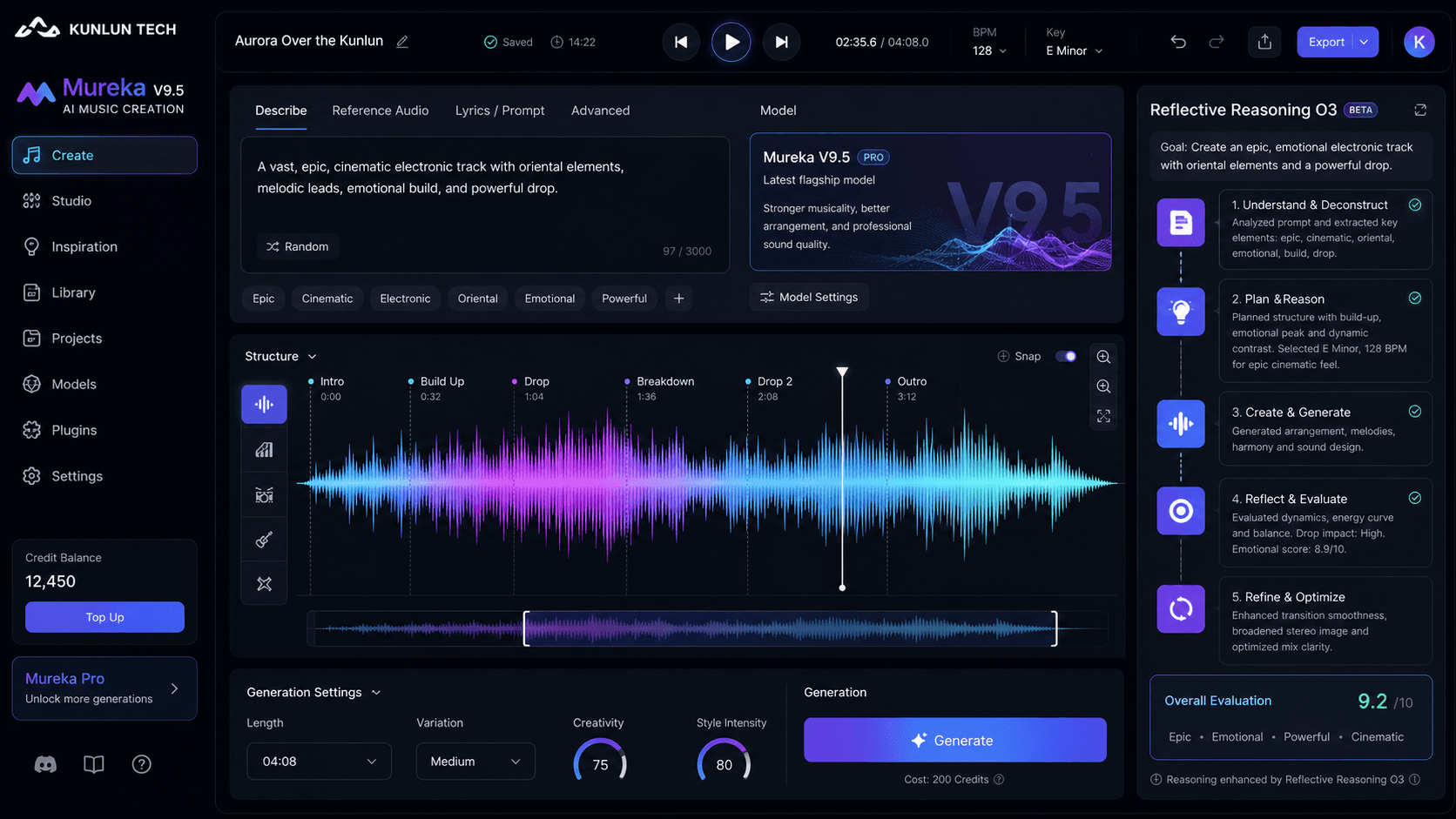
Kunlun's Mureka V9.5 Targets the 'AI Smell' in Machine-Made Music With Reflective Reasoning
Unveiled at WAIC alongside the O3 music reasoning model and Matrix-Game 3.5, the new system trades maximalist arrangements for restraint — and an agentic creation loop that critiques its own compositions.
Chinese tech firm Kunlun has released Mureka V9.5, the latest version of its AI music model — and its pitch is a pointed inversion of the genre's usual bravado: this is, the company says, "the AI music model with the least AI flavor."
Restraint as a feature
Announced at a forum during the World Artificial Intelligence Conference in Shanghai alongside the Matrix-Game 3.5 world model and the O3 music reasoning model, V9.5 attacks the tell-tale artifacts that make generated music instantly recognizable: the wall-of-sound arrangements, over-stacked harmonies and hyperactive production that models use to mask compositional weakness. The new system handles arrangement, vocals and emotional dynamics in a deliberately restrained manner, aiming for tracks that read as written rather than rendered.
Under the hood, the release pairs O3-style reflective reasoning with an agentic creation pipeline called MuCo: the system drafts, critiques and revises its own compositions in a loop — reasoning about intent, structure and instrumentation the way chain-of-thought models reason about math — rather than sampling a finished track in one pass.
Timing with an edge
The release lands in a market suddenly obsessed with exactly this problem. Deezer disclosed this week that AI-generated tracks now exceed half of all daily uploads — some 90,000 songs a day — while attracting just 1-3 percent of streams. The bottleneck for generative music is no longer volume; it is the "AI smell" that keeps listeners away. Kunlun is betting that reasoning-driven restraint, not bigger diffusion decoders, closes that gap — and that production-grade, score-worthy output opens licensing markets in film, games and advertising that slop cannot touch.
It also extends a distinctly Chinese pattern: while US labs concentrate on coding and enterprise agents, Chinese firms keep shipping frontier consumer-creative models — music, video, world models — into markets with immediate monetization. Whether V9.5's blind-test claims survive contact with skeptical musicians remains to be seen once wider access rolls out. But the framing itself marks a maturation point: the first generation of AI music tried to impress; this one is trying to pass.
Newsletter
Get Lanceum in your inbox
Weekly insights on AI and technology in Asia.
More in Research

Google Ships Gemini 3.8 Flash and a 'Cyber' Twin That Hunts Vulnerabilities

Meta's Muse Spark 1.3 Reaches the Frontier: 75.4% on DeepSWE, 1M Context, and a Data-for-Discount Endpoint
