80 Million Exposed, 67% Untouched: Decoding the ILO's Landmark Report on AI and ASEAN's Workers
The headline number sounds alarming, but the real story is subtler — and more worrying: Southeast Asia's AI disruption will be unequal by country, sector, and gender.
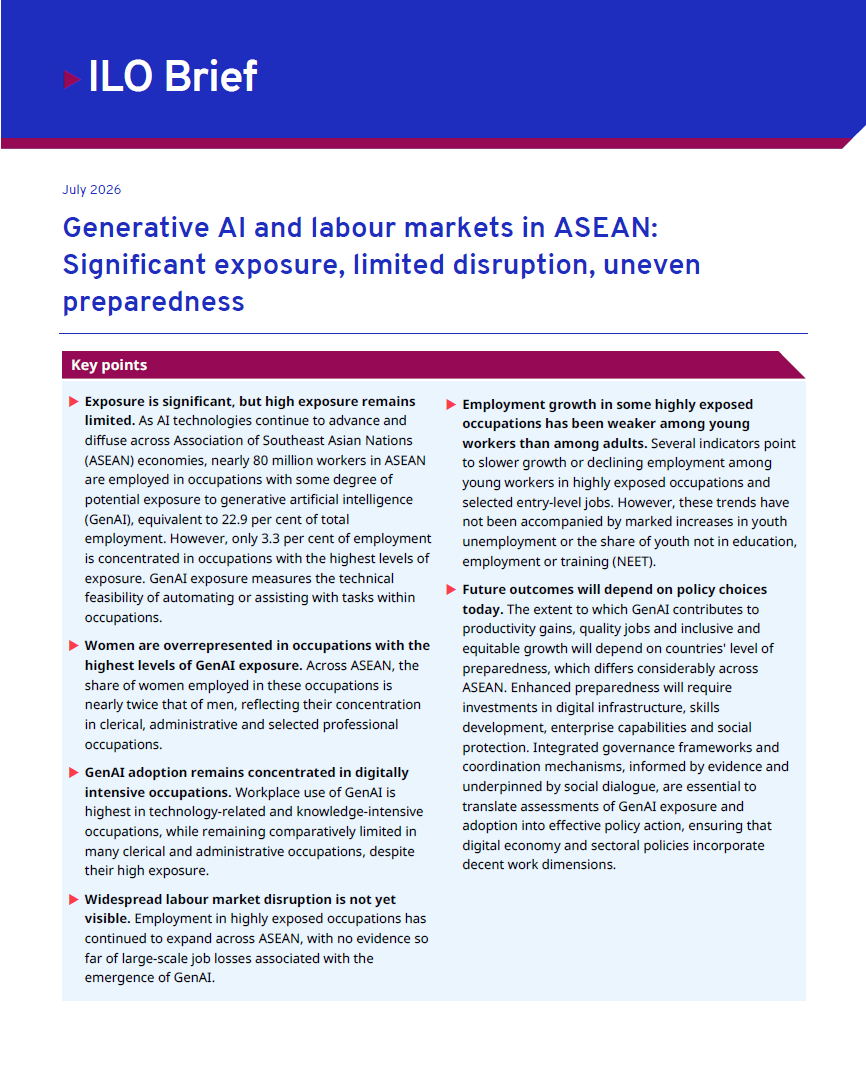
The International Labour Organization's new study of generative AI and ASEAN labour markets arrives with a headline built for anxiety: nearly 80 million workers — 22.9% of the region's employment — sit in occupations exposed to generative AI. But read past the topline and a more complicated picture emerges, one that says as much about Southeast Asia's economic structure as it does about the technology.
The Anatomy of "Exposure"
Start with what the number actually measures. The ILO's methodology assesses technical exposure — whether tasks within an occupation could plausibly be automated or augmented by current generative AI — not whether they will be. Of the 80 million exposed workers, only 11.7 million (3.3% of regional employment) are in the highest-exposure category where automation, rather than augmentation, is the likelier outcome.
Meanwhile, 67% of ASEAN jobs show no identified exposure at all. That's not a comfort blanket; it's a structural portrait. Southeast Asia remains a region of farmers, drivers, construction workers, street vendors, and factory operators — work that language models cannot touch. The AI disruption, when it comes, will be concentrated in a narrow, visible, urban slice of the labour market: offices, call centers, and the formal service economy.
The BPO Question
That concentration is why the Philippines deserves particular attention. At 28.1%, it has ASEAN's second-highest exposure share — and unlike Singapore's 42.2%, which reflects a wealthy economy with deep adaptive capacity, the Philippine number is dominated by the business process outsourcing industry: over a million workers whose jobs exist precisely because they perform routine cognitive work more cheaply than workers in richer countries.
Generative AI attacks that arbitrage directly. Customer service, transcription, basic accounting, content moderation — the BPO bread-and-butter — are among the most automatable task clusters in the ILO's framework. The industry's counter-thesis is that AI turns each agent into a supervisor of a dozen AI conversations, moving Filipino workers up the value chain. The uncomfortable early evidence from enterprise adoption elsewhere is that "AI plus fewer humans" is the configuration companies actually choose.
The Preparedness Gap Is the Real Story
The report's most consequential finding hides in its subtitle: "uneven preparedness." Singapore is spending over S$1 billion on public AI research and has woven AI skills through its education system. Vietnam has passed Southeast Asia's first comprehensive AI law, paired with a development fund. At the other end, several ASEAN members lack the digital infrastructure, training systems, and social protection to cushion any labour transition at all.
This is how AI could widen the region's development gaps rather than narrow them. The optimistic scenario — where AI lets emerging economies leapfrog, giving every small business a marketing department and every clinic a diagnostic assistant — requires connectivity, skills, and capital that are precisely what the least-prepared members lack. Without deliberate policy, the productivity dividends will pool in Singapore, Kuala Lumpur, and Bangkok while the costs land on Manila's call-center floors.
No Disruption Yet Is Not No Disruption
The ILO is careful to note it finds no evidence of large-scale AI-driven job losses to date. That matches global data: two years into the enterprise AI boom, aggregate employment effects remain modest. But the reasons for the lag are temporary — enterprise adoption cycles are slow, agentic systems are only now maturing, and the cost of frontier capability is collapsing on a curve that resembles GLM-5.2's pricing more than GPT-4's.
The report's real message to ASEAN governments is about timing: the region has been handed a preparation window that the technology's trajectory suggests will not stay open long. Eighty million workers' jobs will be reshaped — the open question is whether by design or by default.
Newsletter
Get Lanceum in your inbox
Weekly insights on AI and technology in Asia.