ASEAN's Third Way: Why Singapore and Indonesia Are Redefining AI Sovereignty
At the Asia Economic Summit in Jakarta, the region's two digital heavyweights argued that sovereignty means pragmatic choices and harmonized rules — not building everything at home.
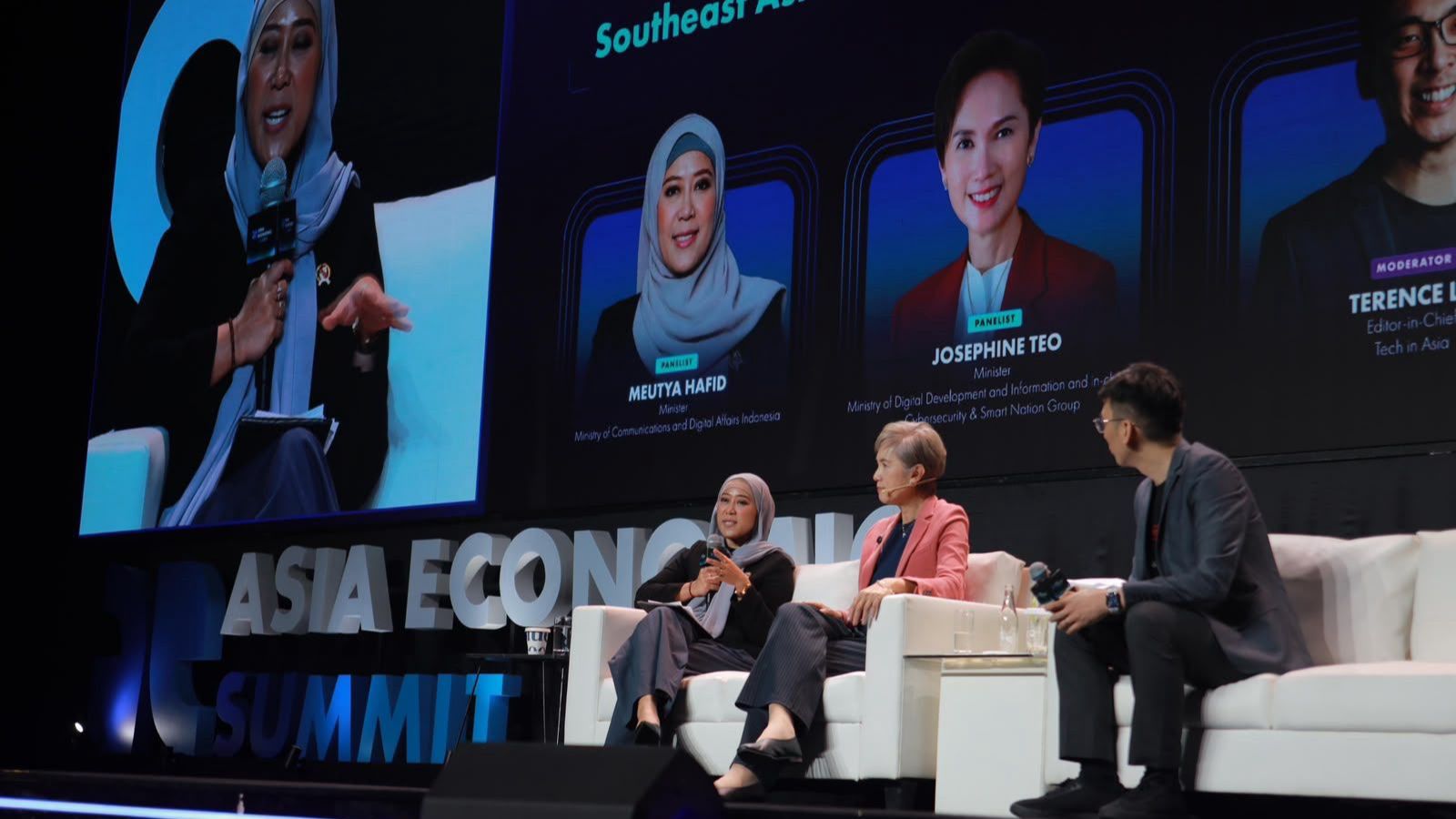
While Washington and Beijing wall off their AI ecosystems and Europe regulates its own, Southeast Asia is quietly articulating a third position. At the Asia Economic Summit 2026 in Jakarta, Singapore's digital development minister Josephine Teo and Indonesia's communications minister Meutya Hafid made the case that AI sovereignty, for ASEAN, cannot mean autarky — it means pragmatic technology choices, harmonized regulation, and ensuring the benefits actually reach businesses and citizens.
Sovereignty Without Silicon
The argument cuts against the prevailing global mood. Sovereign AI has become shorthand for national foundation models, domestic data centers and homegrown chips — a game that requires capital most ASEAN members simply do not have. Teo and Hafid's counter-proposition: the region's advantage lies not in duplicating the US-China capex race but in being the world's most interoperable, well-governed adopter.
That is a sovereignty of rules rather than silicon. The centerpiece is the proposed Digital Economy Framework Agreement (DEFA), which would create consistent digital rules across ASEAN's ten members — data flows, AI governance, digital trade — turning a fragmented region of 680 million people into something closer to a single digital market.
The Money Is Already Voting
Hyperscalers have effectively endorsed the strategy with their balance sheets. AWS has pledged $6 billion each to Malaysia and Indonesia, Microsoft committed $1.7 billion to Indonesia — its largest-ever investment there — and Google put $1 billion into its first Thai data center. The capital flows precisely because the region positioned itself as open infrastructure ground rather than a protectionist thicket.
Singapore anchors the model. Its National AI Strategy 2.0, backed by more than S$500 million and fifteen national AI projects, remains Southeast Asia's most comprehensive government roadmap — and as ASEAN chair, the city-state is pushing regional AI adoption and cross-border data flows to the top of the bloc's agenda.
The Bilateral Engine
The Jakarta summit followed the Indonesia-Singapore Leaders' Retreat, where the two countries signed 26 agreements including AI-enabled trade facilitation for Indonesian SMEs. This bilateral layer matters: where ASEAN-wide consensus moves slowly, Singapore-Indonesia agreements create working templates the rest of the bloc can adopt.
The Risks in the Middle
The pragmatic path has real vulnerabilities. Dependence on foreign models — American or Chinese — leaves the region exposed to exactly the kind of access restrictions both superpowers are now contemplating. Beijing's reported deliberations over limiting exports of its best open-weight models would hit ASEAN's startups hardest, since so many build on Qwen and GLM derivatives.
The pragmatists' bet is that neutrality plus interoperability buys resilience: if any single supplier cuts access, a well-governed, standards-based market can switch. Whether that holds in a genuine decoupling is the great untested assumption of ASEAN's third way. For now, it is attracting more capital per unit of sovereignty rhetoric than any strategy on offer.
Newsletter
Get Lanceum in your inbox
Weekly insights on AI and technology in Asia.