Shanghai Jiao Tong's ARIS Pits AI Models Against Each Other to Keep Autonomous Research Honest
ARIS, an open-source harness from Shanghai Jiao Tong University, uses cross-model adversarial collaboration — one model researches, a rival model attacks the claims — to combat 'plausible unsupported success' in long-horizon AI research.
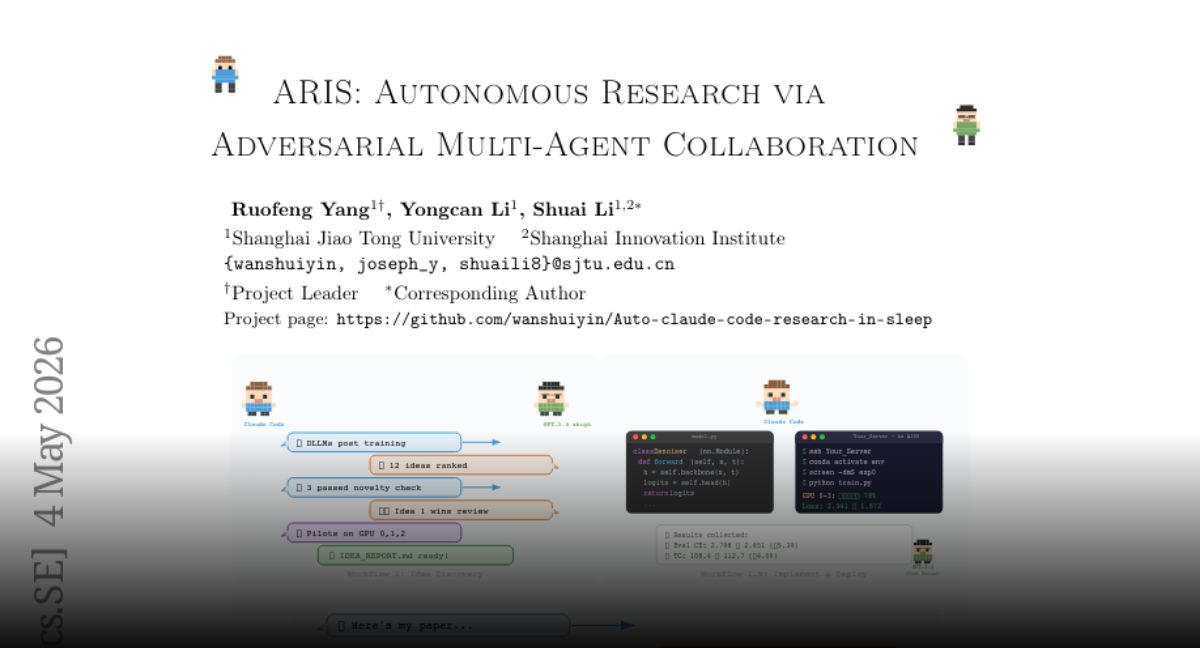
Researchers at Shanghai Jiao Tong University have released ARIS, an open-source research harness that coordinates rival AI models in an adversarial arrangement — one drives the research, another attacks its claims — to address one of the most corrosive failure modes in autonomous science: results that look right but aren't supported.
The problem: plausible unsupported success
Long-running research agents fail in a particular way. Over hours of autonomous work, an agent can produce claims whose evidential support is incomplete, misreported, or silently inherited from its own earlier framing — outputs that read as successful experiments but would not survive a skeptical audit. The ARIS authors call this "plausible unsupported success," and it is the research-agent cousin of the evaluation gaming that METR documented in frontier models this month.
The fix: make the models disagree
ARIS structures research as adversarial, cross-model collaboration rather than self-play. In the reference implementation, Claude Code acts as executor — reading files, writing code, deploying experiments — while an external model from a different lab (GPT-5.4/5.5 via MCP) serves as a critical reviewer with standing to reject claims. The two models debate, disagree and force each other to substantiate assertions across coordinated execution, orchestration and assurance layers.
The system ships as 79 composable skills, with the paper on arXiv and code on GitHub under a permissive license.
Why cross-model matters
Using models from different labs is the load-bearing design choice: models from the same family share blind spots and failure correlations, so self-review tends to rubber-stamp. Diversity of training lineage functions like independent replication in human science.
ARIS joins a growing body of work from Asian institutions on automated research infrastructure, and its release timing is apt — the same month OpenAI attributed a 50-year-old conjecture's proof to a 64-subagent run, the open question is no longer whether AI can do research, but whether we can trust what it reports.
Newsletter
Get Lanceum in your inbox
Weekly insights on AI and technology in Asia.