Three Weeks On, Kimi K2.7-Code Shows the Promise — and the Problem — of Vendor Benchmarks
Moonshot AI's open-weight coding model posts double-digit gains and claims a win over Claude Opus 4.8, but every headline number comes from Moonshot's own benchmark suite.
Three weeks after Moonshot AI released Kimi K2.7-Code on June 12, the model has settled into a familiar pattern for China's open-weight surge: impressive numbers, aggressive pricing, and a lingering asterisk. It is the fifth major Kimi release in under a year — and every headline benchmark it shipped with belongs to Moonshot itself.
A Trillion Parameters, Tuned for Agents
K2.7-Code is a Mixture-of-Experts model with 1 trillion total parameters, activating 32 billion per token across 384 experts, with a 256K-token context window and native INT4 quantization. The weights — roughly 595 GB — are available on Hugging Face under a Modified MIT license, with API pricing at $0.95 per million input tokens and $4.00 per million output tokens.
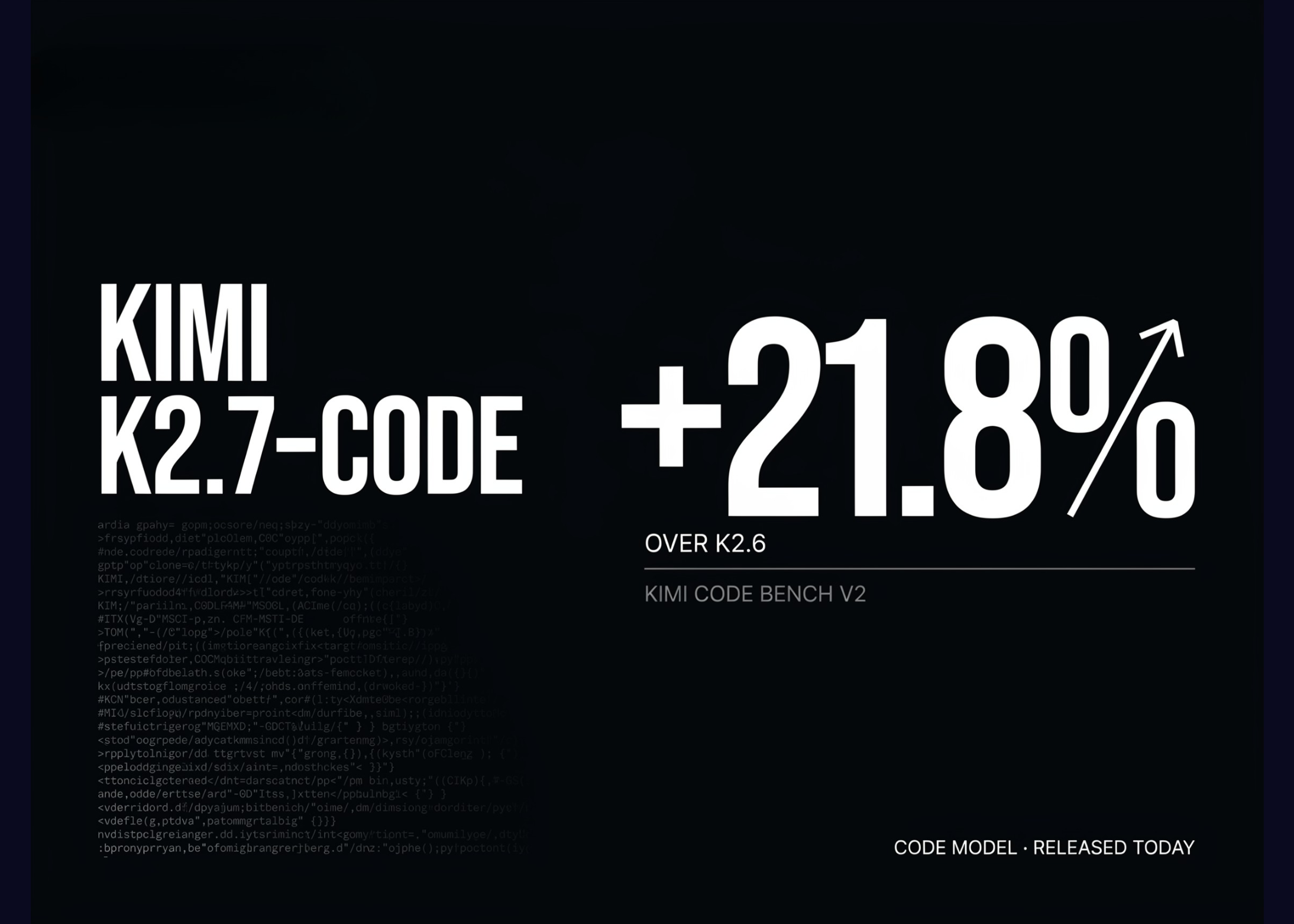
The vendor-reported gains over K2.6 are substantial: +21.8% on Kimi Code Bench v2 (50.9 to 62.0), +11.0% on Program Bench, and +31.5% on MLS Bench Lite. On MCP Mark Verified, a tool-use evaluation, Moonshot reports 81.1 — ahead of the 76.4 it attributes to Anthropic's Claude Opus 4.8.
The release's most practical claim may be efficiency: Moonshot says K2.7-Code cuts reasoning-token usage by roughly 30% versus K2.6. In agentic workflows, where thinking tokens accumulate across dozens of steps, that compounds directly into lower bills. Notably, thinking mode is mandatory and cannot be disabled, with sampling parameters fixed server-side.
The Asterisk
Here is the caveat that matters: all of those numbers are Moonshot's own. Kimi Code Bench v2, Program Bench, MLS Bench Lite, and MCP Mark Verified are proprietary benchmarks, and at release there were no independent third-party results on community standards such as SWE-bench Verified, LiveCodeBench, or GPQA Diamond. As MarkTechPost noted, all headline numbers are first-party at launch, and independent verification is still pending.
That does not make the numbers wrong. But a lab grading itself on tests it wrote is a different evidentiary standard than an external leaderboard, and the gap between the two has become one of the defining tensions of the current release cycle. Industry analysts quoted by DevOps.com offered pragmatic advice: token-efficiency advantages tend to be transitory as competitors catch up, and teams should test against their actual workloads rather than relying on vendor benchmarks.
China's Open-Weight Cadence
Viewed alongside its peers, K2.7-Code fits a clear pattern. Chinese labs — Moonshot, Zhipu, Z.ai, ByteDance, Alibaba — are shipping open-weight agentic coding models on a cadence Western frontier labs do not match, and pairing them with permissive licenses and low prices. Five major Kimi releases in under twelve months is a statement of tempo as much as capability.
The open question is whether tempo plus self-reported scores can build the trust that enterprise adoption requires. Until neutral evaluations land, K2.7-Code is best read as a credible, cheap, genuinely open contender — whose exact position on the leaderboard remains, for now, Moonshot's word.
Newsletter
Get Lanceum in your inbox
Weekly insights on AI and technology in Asia.