Meituan Open-Sources LongCat-2.0: A 1.6T-Parameter Coding Model Trained Entirely on Chinese Chips
The MIT-licensed agentic coding model was trained from scratch on a 50,000-card cluster of domestic accelerators — the strongest evidence yet that China's AI stack can reach near-frontier scale without Nvidia.
Meituan — the Chinese food-delivery giant better known for scooters than supercomputers — has open-sourced LongCat-2.0, a 1.6-trillion-parameter agentic coding model released under the MIT license. The headline is not just the scale: Meituan says the model was trained from scratch on a 50,000-card cluster of domestically designed AI accelerators, with no Nvidia hardware in the training run.
The Model
LongCat-2.0 uses a Mixture-of-Experts architecture tuned specifically for agentic coding — long-horizon tasks where a model plans, edits, executes and iterates across a codebase — and carries a million-token context window, putting it on par with DeepSeek's latest flagship. Prior LongCat releases had quietly built a following among developers; the family has been leading portions of OpenRouter's usage charts, making this less a debut than a coronation.
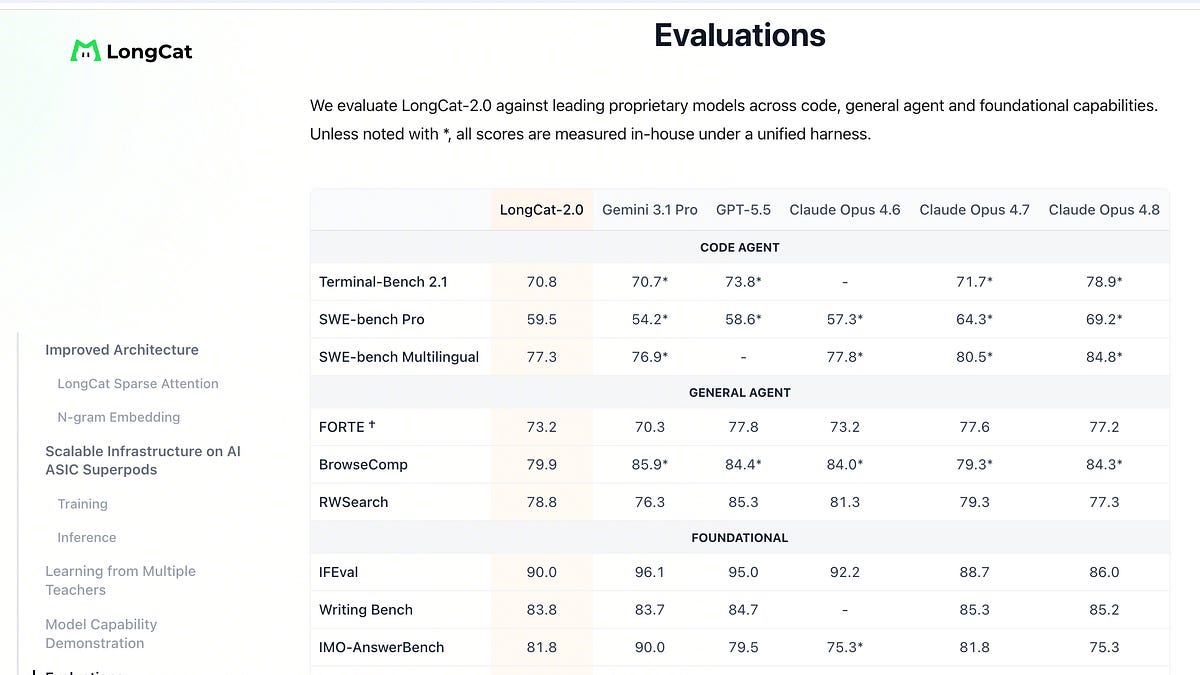
Early benchmark claims place it near the frontier of open coding models, in the territory contested by Z.ai's GLM-5.2 and Moonshot's Kimi coding line. Independent verification, as always, will take weeks.
Why the Silicon Matters More Than the Scores
Every previous Chinese frontier-scale model carried an asterisk: trained on stockpiled or gray-market Nvidia GPUs, and therefore hostage to export-control enforcement. LongCat-2.0 removes the asterisk. A 1.6-trillion-parameter training run completed on a 50,000-card domestic ASIC cluster is the strongest public evidence to date that China's homegrown compute stack — chips, interconnects, software — now functions at near-frontier scale.
That claim lands directly in Washington's blind spot. US policy has assumed that restricting advanced chips would cap Chinese model quality; a credible domestic training stack converts that assumption into a countdown.
The Unexpected Messenger
That the proof came from Meituan, rather than a dedicated AI lab, is its own signal. China's tech giants are converting consumer-internet cash flows into sovereign-scale AI infrastructure, and open-sourcing the results under permissive licenses to win global developer adoption. With LongCat-2.0 joining GLM-5.2, DeepSeek V4 and the Qwen line, Chinese labs now supply most of the world's leading open-weight models — increasingly, on Chinese silicon end to end.
Newsletter
Get Lanceum in your inbox
Weekly insights on AI and technology in Asia.