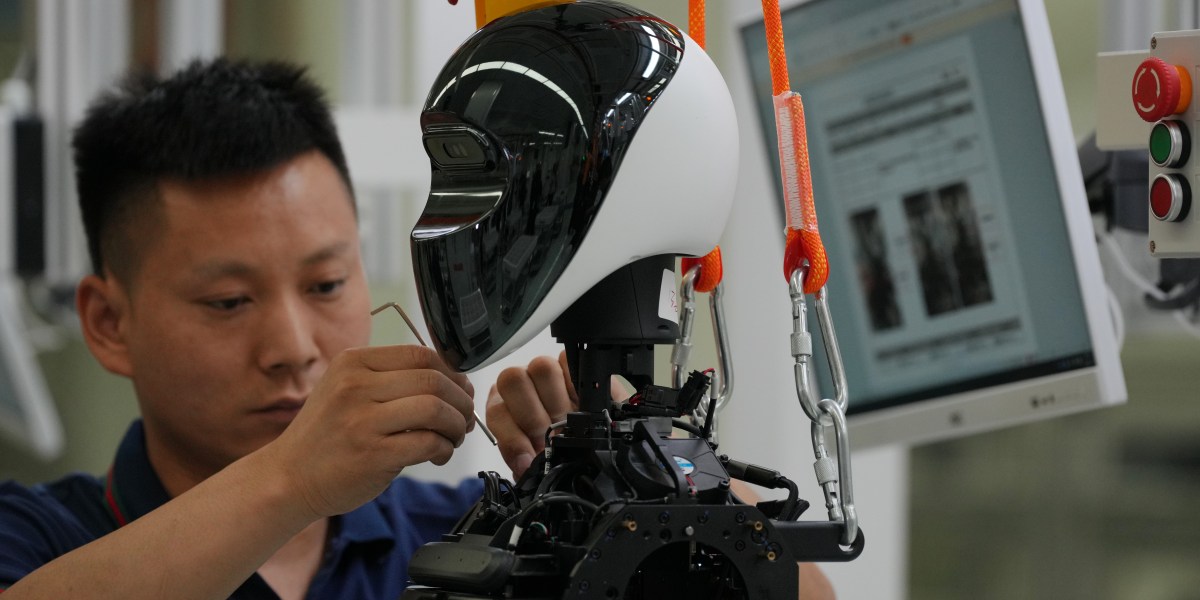
China Builds 85% of the World's Humanoids. Now Comes the Hard Part: Finding Buyers
Chinese factories can ship cheap humanoid robots at unprecedented scale — sorting mail, pouring coffee, working demo lines. But supply-side dominance is colliding with a demand problem no subsidy can fix.
China has won the first phase of the humanoid robot race so decisively that the scoreboard is almost boring. Of the more than 13,000 humanoids shipped worldwide in 2025, Shanghai's AgiBot and Hangzhou's Unitree each moved over 5,000 units; Chinese firms control roughly 85-90% of global installations. Morgan Stanley expects Chinese humanoid sales to more than double in 2026, to around 28,000 units. The 15th Five-Year Plan has made robotics the spine of the "modern industrial system," and Beijing's nationwide embodied-AI program requires key humanoid products to enter "work mode" — regular deployment in representative scenarios — by year's end.
And yet the most important question in the industry right now is not who can build humanoids. It's who will buy them.
The Supply Machine
China's dominance follows a familiar template: the EV playbook, run faster. Local governments compete to host robotics clusters with land, subsidies and procurement guarantees. Component supply chains — actuators, reducers, sensors — sit within a two-hour drive of assembly lines in the Yangtze and Pearl River deltas. Prices have collapsed accordingly: capable platforms now sell for the price of a mid-range sedan, and Unitree's entry models cost less than a high-end gaming PC.
The result is a manufacturing flywheel the West cannot currently match. When Unitree's $619 million STAR Market IPO cleared, it was oversubscribed on the premise that shipping volume is destiny.
The Demand Gap
But walk past the trade-show demos and the picture blurs. Fortune's reporting captured the industry's open secret: robots that sort mail, stack boxes and pull espresso shots in pilots are struggling to convert into fleets doing economically load-bearing work. The buyers so far are disproportionately universities, research labs, state-owned enterprises fulfilling policy mandates, and other robot companies — a market that looks uncomfortably circular.
Three gaps explain the hesitation. First, reliability: pilot robots still require human minders, and uptime in unstructured environments remains far below industrial-automation norms. Second, ROI math: at current capability levels, a humanoid competes not with a worker but with a conveyor, an arm, or simply reorganizing the workflow — all cheaper. Third, the software ceiling: hardware has outrun the embodied intelligence needed to generalize across tasks, which is precisely why Chinese firms are racing to close the gap with vision-language-action models and why Beijing's program pairs robot subsidies with foundation-model mandates.
Why the Mandate May Still Work
It's tempting to read this as a bubble, and parts of it are. But China's industrial policy has a specific advantage in demand creation: it can conscript early adopters. State grid inspections, ports, elder-care pilots, hazardous-environment work in chemicals and mining — the plan explicitly channels humanoids into scenarios where the state is the customer and tolerance for imperfect ROI is high. That guaranteed floor lets manufacturers iterate on real deployment data that Western rivals, waiting for the market to volunteer, won't have.
The Japanese comparison is instructive. When Japan Airlines committed humanoids to Haneda Airport operations, the significance wasn't the robots — it was a safety-obsessed legacy carrier signing a multi-year operational contract. Demand in this industry is created by institutional risk absorption, and China has more institutions willing to absorb risk than anyone.
The Shakeout Ahead
The likeliest path is neither triumph nor collapse but consolidation. Dozens of the hundred-plus Chinese humanoid makers will not survive the transition from subsidy-funded supply to revenue-funded demand; the survivors — Unitree, AgiBot, UBTech and a handful of others with real deployment data — will emerge with cost structures and datasets no one else on earth possesses.
The West's comfort has been that China builds bodies while America builds brains. That comfort has a clock on it. If the demand problem gets solved — by mandate, by capability, or by both — the country that already owns the factories, the components and the installed base will own the market. Finding buyers is the hard part. It is also, historically, the part China's industrial machine figures out last — and then all at once.
Newsletter
Get Lanceum in your inbox
Weekly insights on AI and technology in Asia.