PixWorld Unifies 3D Reconstruction and Generation in Pixel Space
A single diffusion model from NTU handles both rebuilding real 3D scenes and generating new ones — by supervising directly on pixels instead of a compressed latent code.
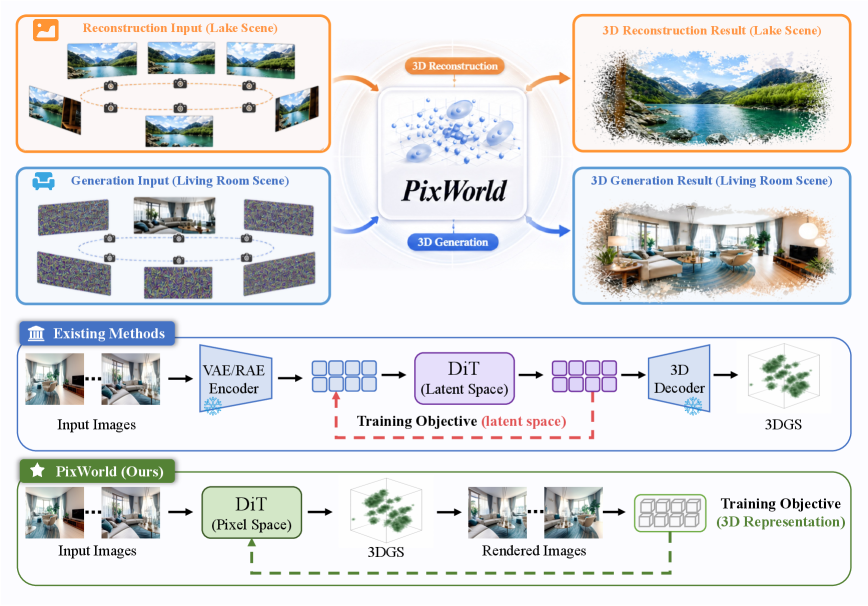
Two tasks that sound similar have long lived in separate worlds: reconstructing a 3D scene from photographs, and generating a plausible 3D scene from scratch. PixWorld, a paper from researchers at Nanyang Technological University published July 6 on arXiv and Hugging Face, brings both under one roof with a single diffusion model — and does so by rethinking where the model is supervised.
The latent-space bottleneck
Most recent 3D generation systems operate in latent space. An image is compressed into an abstract code, the model works there, and the result is decoded back to pixels. It is efficient, but the compression is lossy: fine geometric detail can be discarded, and the model's objective becomes only loosely tied to how the final scene actually looks. That mismatch shows up as blurry surfaces and geometry that does not quite hold together.
Supervising the pixels directly
PixWorld drops the latent detour. It supervises the diffusion process directly on rendered images, so the optimization target aligns with 3D scene fidelity itself rather than a compressed proxy. But raw 2D image supervision alone does not guarantee correct 3D structure — a scene can look right from one view and be geometrically wrong. To fix that, PixWorld adds a geometry perception loss: it compares rendered views against ground truth not just pixel-for-pixel, but inside the geometry-aware feature space of a pretrained 3D foundation model. That injects genuine 3D structural supervision, pushing the model toward scenes that are consistent across viewpoints, not just individual frames.
Results and why it matters
The single unified model is competitive on both fronts. PixWorld consistently outperforms prior latent-space generation methods while matching state-of-the-art dedicated reconstruction methods — a rare combination, since systems tuned for one task usually give up ground on the other.
The significance is twofold. Practically, one model that both reconstructs and generates simplifies the pipeline for graphics, robotics simulation, and world-model research. Conceptually, PixWorld is evidence that pixel-space supervision, long dismissed as too expensive, can beat the latent-space paradigm that has dominated the field — a reminder that the compressed representations most generative systems rely on come at a real cost to fidelity.
Newsletter
Get Lanceum in your inbox
Weekly insights on AI and technology in Asia.