Embodied.cpp Wants to Be the llama.cpp of Robots
A portable C++ runtime aims to end the fragmentation of deploying vision-language-action and world-action models across heterogeneous robots and edge hardware.
The models that let robots see, reason, and act have advanced quickly. Getting them to run reliably on real hardware has not. A new paper from the PhysicalAI System Group at Southeast University, published July 2 on arXiv and Hugging Face, tackles that gap with Embodied.cpp — a portable C++ inference runtime for embodied AI models, pitched as a robotics-native counterpart to the lean runtimes that made large language models easy to deploy.
The deployment problem
Embodied AI now spans two big model families: vision-language-action (VLA) models that map perception to motor commands, and world-action models (WAMs) that predict how a scene evolves. In practice, deploying them is a mess. Each model ships with its own Python stack, its own backend assumptions, and a pile of robot-side glue code — and it all has to run on wildly different edge hardware, from CPUs to GPUs to NPUs.
Worse, most existing inference runtimes were built for cloud-style request-response serving. Robots need something different: multi-rate execution inside a closed control loop, latency-first inference at batch size one, and interfaces that go beyond fixed text tokens to handle sensor streams and motor outputs.
One backend, five layers
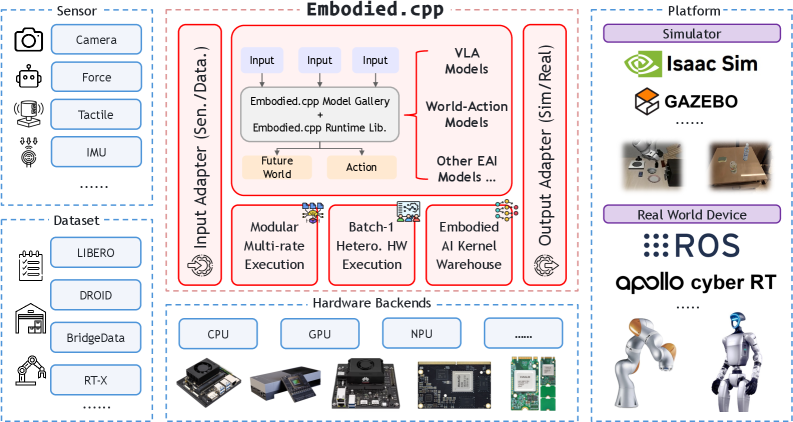
The authors analyzed representative VLA and WAM architectures and found a shared execution path they could generalize. Embodied.cpp organizes it into five modular layers: input adapters, sequence builders, backbone execution, head plugins, and deployment adapters. That structure lets a single backend abstraction target many devices, robots, and simulators at once. It offers modular multi-rate execution, latency-first fused inference, and extensible operator and I/O support, and — like the runtimes that inspired it — loads models from portable GGUF weight files across CPU, CUDA GPU, and NPU targets.
Why it matters
Robotics has lacked a common deployment substrate. By abstracting away the fragmented, model-specific stacks, Embodied.cpp could do for physical AI what lightweight runtimes did for LLMs: turn deployment from a bespoke engineering project into a solved problem. That lowers the barrier for smaller labs and companies to put capable models on real robots, and it arrives as physical AI becomes one of 2026's most contested frontiers. The code is available openly on GitHub.
Newsletter
Get Lanceum in your inbox
Weekly insights on AI and technology in Asia.