Agents-A1: A 35B Agent That Matches Trillion-Parameter Models by Scaling the Horizon
A Shanghai lab argues the path to stronger AI agents runs through longer task trajectories, not bigger models — and backs it with a 35B system that rivals 1T-parameter rivals.
Bigger has been the reflexive answer to almost every question in AI. A new open-weights release from InternScience — a group within the AI for Science Center at Shanghai AI Laboratory — makes a pointed counterargument. Titled "Scaling the Horizon, Not the Parameters," the work introduces Agents-A1, a 35-billion-parameter Mixture-of-Experts model that reaches the performance of trillion-parameter systems on demanding agentic tasks. It landed on Hugging Face's daily papers on June 30 under an Apache-2.0 license.
Scaling the horizon, not the parameters
The central idea is "agent-horizon scaling." Rather than adding parameters, the team scales two other things: the length of the task trajectories a model learns from, and the breadth of specialized agent abilities it absorbs. To fuel this, they built a knowledge-action infrastructure that stitches together external knowledge, actions, observations, and verifier outcomes into coherent trajectories averaging 45,000 tokens — long, multi-step problem-solving episodes that resemble real agentic work far more than a typical question-answer pair.
A three-stage training recipe
Agents-A1 is trained in three stages. First, full-domain supervised fine-tuning aligns the base model with broad agentic behavior. Second, the team trains domain-level teacher models, each capturing deep expertise in one area — science, coding, browsing, and so on. Third, and most novel, is a multi-teacher domain-routed on-policy distillation step with "salient vocabulary alignment," which transfers each teacher's specialized skill back into the single student model efficiently. The result is a compact model that inherits a committee's worth of expertise.
Results and why it matters
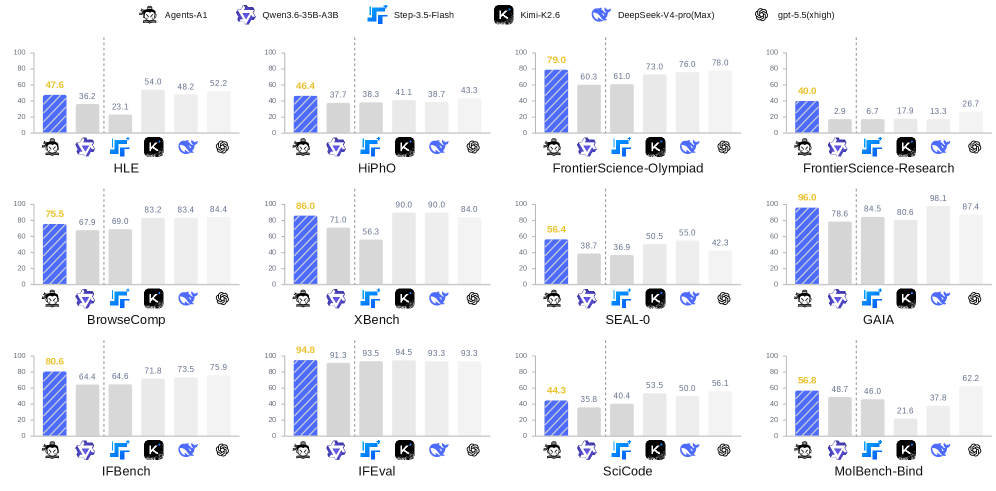
Against 1T-parameter models such as Kimi-K2.6 and DeepSeek-V4-pro, Agents-A1 leads on several benchmarks — SEAL-0 (56.4), IFBench (80.6), the physics olympiad HiPhO (46.4), FrontierScience-Olympiad (79.0), and MolBench-Bind (56.8) — while staying competitive on SciCode, Humanity's Last Exam, and BrowseComp.
If the finding holds, it reshapes the economics of capable agents. A 35B model costs a fraction of a trillion-parameter one to run, so matching that tier through better training data and distillation — rather than raw scale — could put frontier-grade agents within reach of far smaller budgets. It is also another data point in a 2026 trend: China-origin labs releasing open weights that pressure the closed frontier from below.
Newsletter
Get Lanceum in your inbox
Weekly insights on AI and technology in Asia.
More in Research
Kimi K3's Weights Are Out: 2.8T Parameters, a 1.4TB Download, and an Escalation Nobody Can Undo

MeetingToM: A Benchmark for the Social Skill AI Keeps Failing — Telling Real Agreement From Fake