Meta's Brain2Qwerty v2 Decodes Typed Sentences From Brain Activity — No Surgery Required
The non-invasive MEG-based system hits 61% word accuracy, an eightfold leap over prior methods, and Meta has open-sourced the code and dataset.
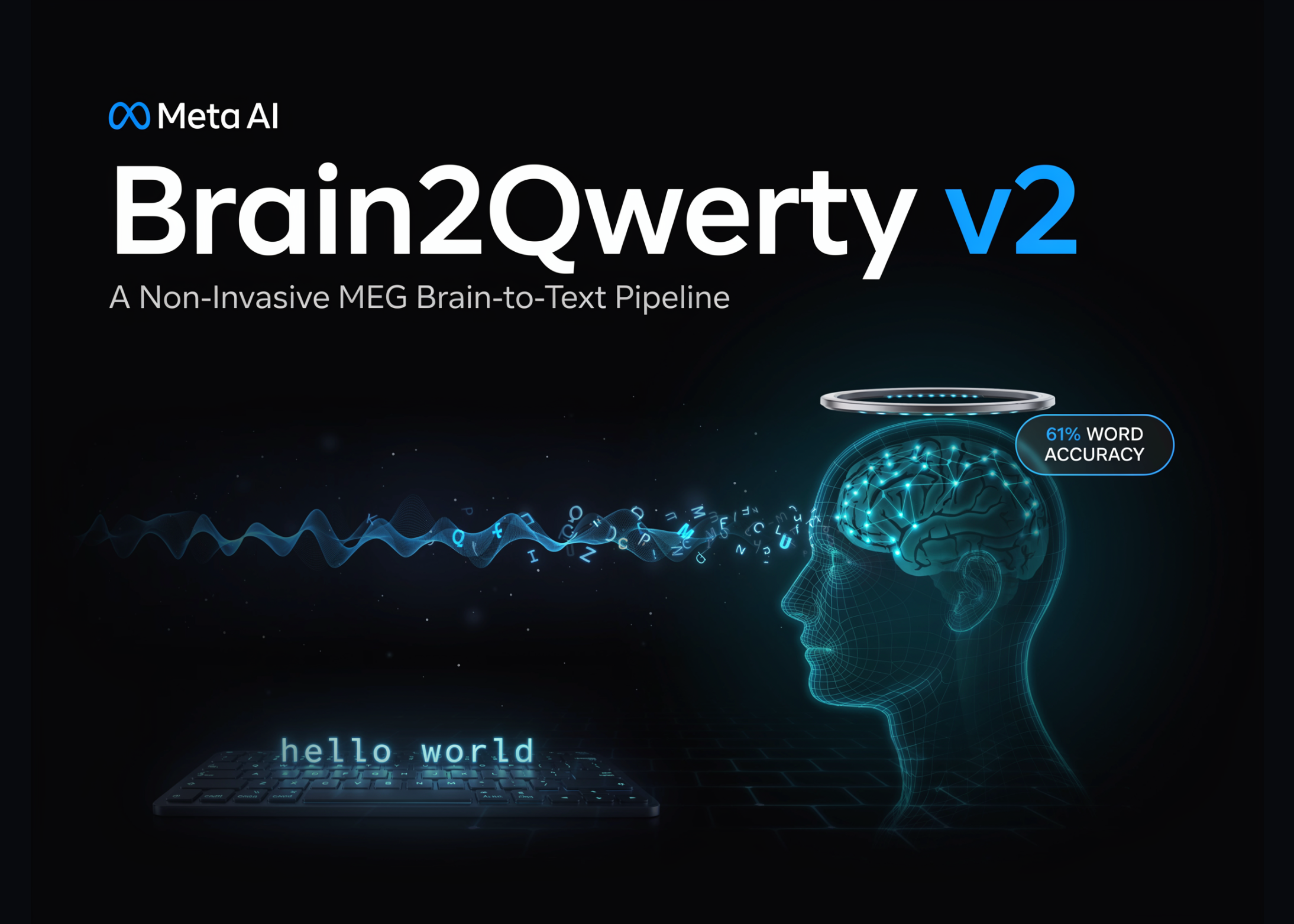
Meta AI has released Brain2Qwerty v2, a system that reconstructs typed sentences from brain activity using non-invasive brain scans — reaching 61% average word accuracy without any surgical implant. It is one of the most significant results yet in the long-frustrated quest to give people who have lost the ability to communicate a path back to language, and Meta has open-sourced the code and dataset alongside it.
An Eightfold Leap
The headline is the jump. Prior non-invasive brain-to-text methods managed roughly 8% word accuracy — far too low for practical use. Brain2Qwerty v2's 61% average, with the best-performing participant reaching 78% and more than half of that person's decoded sentences containing one or fewer word errors, approaches accuracy levels previously achievable only with surgically implanted electrodes.
That matters because implants carry real costs: infection risk, signal degradation over time, and the barrier of brain surgery itself. A non-invasive system that closes most of the accuracy gap would be transformative for patients with brain lesions or neurological disorders.
How It Works
The pipeline feeds raw neural signals from a helmet-like magnetoencephalography (MEG) scanner into a deep-learning model that reconstructs typed sentences. Crucially, the model is fine-tuned against large language models, letting it use semantic context — the statistical structure of plausible sentences — to correct noisy neural decoding. It was trained on roughly 22,000 sentences collected from nine volunteers.
The reliance on MEG is both the breakthrough and the catch: MEG scanners are room-sized and expensive, so this is a laboratory result, not a wearable. But the modeling advance — showing that LLM priors can dramatically boost decoding from noisy non-invasive signals — is portable to whatever sensing hardware comes next.
Open Science
Meta released the code and dataset through its Digital Brain Project, which includes a $5 million fund for open neuroscience datasets — a notable commitment to reproducibility in a field where progress has often been locked behind proprietary clinical data. For the broader research community, an open MEG-to-text benchmark at this accuracy level sets a new bar and a shared foundation to build on.
Newsletter
Get Lanceum in your inbox
Weekly insights on AI and technology in Asia.