Cognition's SWE-1.7 Nears Frontier Coding Performance — Built on China's Kimi K2.7
The Devin maker's new model scores 42.3% on FrontierCode at $1.97 per task, running at 1,000 tokens per second — and challenges the idea of a post-training ceiling.
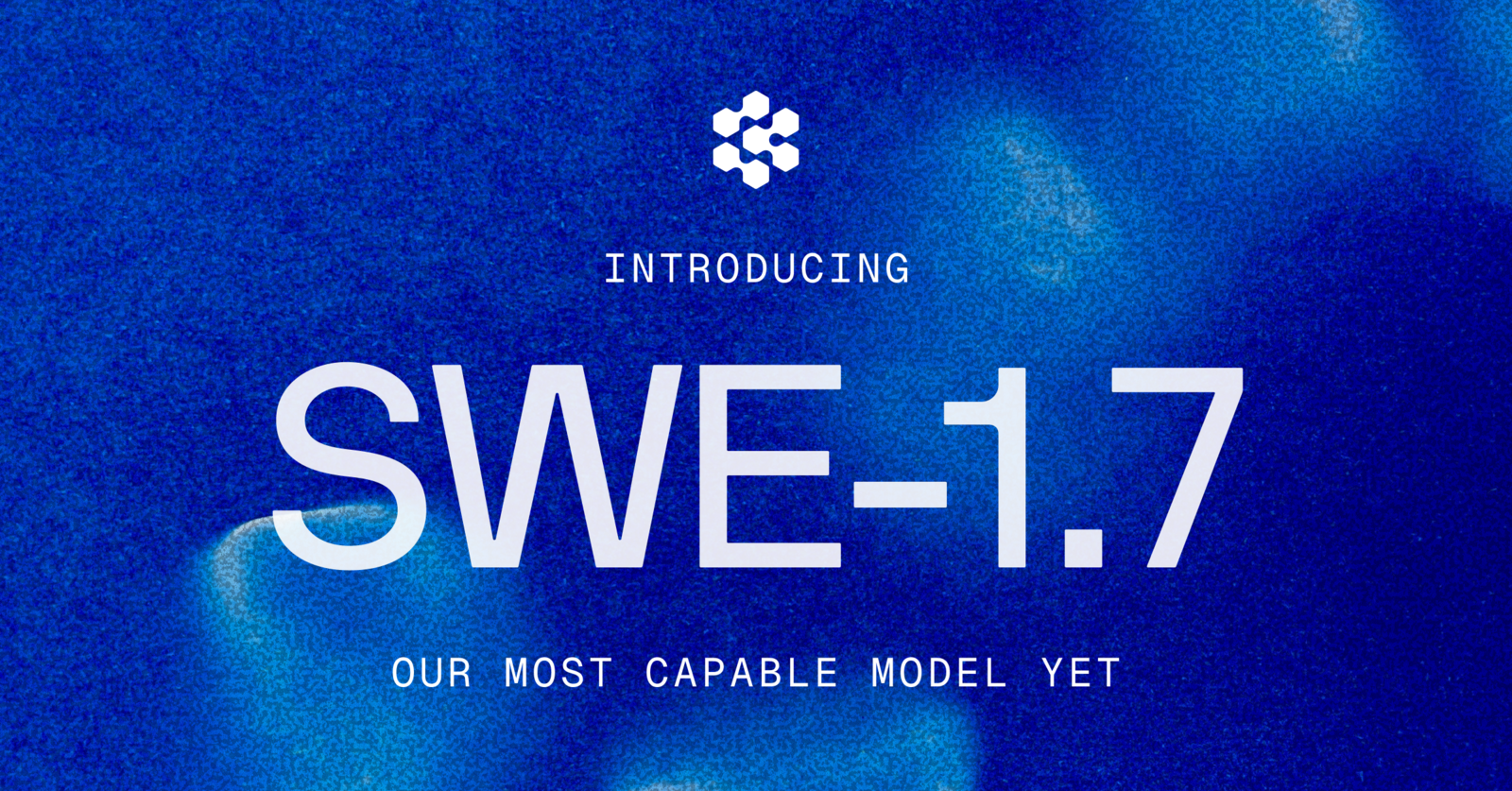
Cognition released SWE-1.7 this week, its most capable software engineering model to date — and one of the clearest demonstrations yet that the line between American AI products and Chinese AI foundations has effectively dissolved. The model was trained from a Kimi K2.7 base, the open-weight model from Beijing's Moonshot AI, with Cognition's reinforcement learning pipeline layered on top.
The Numbers
On FrontierCode 1.1, Cognition's proprietary benchmark measuring whether a model produces code "you'd actually want to merge," SWE-1.7 scores 42.3% — just behind GPT-5.5 at 43.0% and Claude Opus 4.8 at 46.5%. The economics are the headline: $1.97 per task on the benchmark's main set, a fraction of frontier model costs, served at roughly 1,000 tokens per second.
Challenging the Post-Training Ceiling
The research significance lies in what the gains imply. Kimi K2.7 had already undergone extensive RL post-training at Moonshot before release; conventional wisdom held that additional post-training on such a model would yield diminishing returns. Cognition's results — driven by better RL infrastructure, more stable training, higher-quality data and new techniques for long-horizon tasks — suggest that ceiling is much further away than assumed.
That finding matters beyond Cognition. It implies open-weight bases still contain large amounts of extractable capability, and that application companies with strong RL pipelines can keep compounding gains without owning a pretraining run — the same pattern powering the enterprise shift toward customized open models.
An Application Company Acting Like a Lab
Equally notable is who shipped this. Cognition is not an open-source lab releasing weights; it is a product company building a proprietary model to run Devin, its autonomous software engineer, and pricing it aggressively enough to pressure the wider market. With a Chinese base model, American RL, and a proprietary benchmark to prove the result, SWE-1.7 is a compact portrait of how the 2026 AI stack actually gets built — supply chains be damned.
Newsletter
Get Lanceum in your inbox
Weekly insights on AI and technology in Asia.